Protective coatings that extend concrete’s life.
Concrete deteriorates — carbonation, chloride attack, chemical exposure and abrasion all shorten its service life. We apply protective coating systems that shield structural concrete from the elements and the environment, across commercial and industrial SEQ.
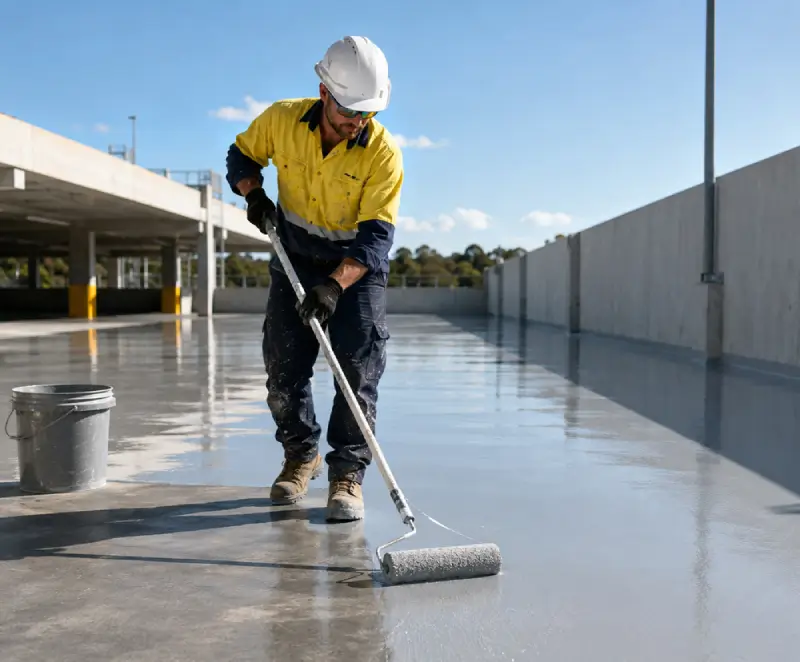
Protecting the concrete protects the steel inside it
Reinforced concrete relies on a chemistry most people never think about. The concrete around the steel is highly alkaline, and that alkalinity forms a passive layer that protects the reinforcement from corrosion. As long as that protection holds, the steel is safe. When it breaks down, the steel rusts, expands, and cracks the concrete apart from within — concrete cancer.
Two processes destroy that protection: carbonation, where atmospheric carbon dioxide gradually neutralises the concrete’s alkalinity from the surface inward; and chloride attack, where salts — from marine air, de-icing or contamination — penetrate and depassivate the steel directly. In coastal South East Queensland, both are constant threats.
Protective coatings are the defence. Anti-carbonation coatings slow the ingress of carbon dioxide; chemical-resistant linings protect against aggressive substances; waterproof and abrasion-resistant coatings shield surfaces from water and wear. Applied correctly, they can add decades to the service life of a structure — for a fraction of the cost of remediation.
The right barrier for the exposure
Anti-carbonation coatings
Coatings that dramatically slow carbon dioxide ingress, protecting reinforcement passivation and extending the life of exposed structural concrete.
Chemical-resistant linings
Epoxy and polyurethane linings for bunds, plant rooms and industrial areas exposed to chemicals, fuels and aggressive substances.
Waterproof coatings
Elastomeric waterproof coatings for facades, walls and decks that keep water out while allowing the substrate to breathe.
Abrasion & traffic coatings
Hard-wearing coatings for car park decks, ramps, loading areas and industrial floors subject to constant traffic and wear.
Carbonation & chloride barriers
Barrier systems selected for the specific deterioration mechanism affecting your structure, coastal or industrial.
Facade protective systems
Protective and decorative coating systems for building facades that combine weather protection with appearance.
Preparation determines performance
Assess the exposure
We identify the deterioration mechanism — carbonation, chlorides, chemicals, abrasion, UV — and select a coating system matched to that specific threat.
Repair the substrate
Any existing concrete damage, spalling or contamination is repaired and made sound. A coating over failing concrete simply hides the problem temporarily.
Prepare the surface
The concrete is mechanically prepared to the correct profile and cleanliness — the single biggest factor in coating adhesion and longevity.
Apply to specification
The coating system applied in the correct number of coats to the specified film thickness, with inspection and documentation throughout.
The threats a coating defends against
Choosing a coating starts with understanding what is attacking the concrete. These are the mechanisms we protect against in the SEQ environment.
- Carbonation — atmospheric CO₂ neutralises the concrete’s alkalinity, depassivating the steel; slowed by anti-carbonation coatings.
- Chloride attack — salts from marine air penetrate and corrode reinforcement directly; resisted by barrier coatings.
- Chemical exposure — fuels, oils and industrial chemicals degrade concrete; contained by chemical-resistant linings.
- Abrasion & traffic — mechanical wear erodes surfaces; protected by hard-wearing traffic-grade coatings.
- Water & moisture — the vehicle for most deterioration; excluded by waterproof coating systems.
- UV & weathering — intense Queensland UV degrades unprotected surfaces; addressed with UV-stable systems.
Concrete Protective Coatings FAQs
Concrete cancer is the cracking and spalling caused when reinforcing steel corrodes and expands within concrete. Protective coatings help prevent it by slowing the carbonation and chloride ingress that trigger corrosion. Where corrosion has already started, coatings are applied after concrete repair as part of a remediation system, not as a standalone cure.
It depends on the system, the exposure and the preparation, but quality protective coatings typically deliver many years of service before recoating. Anti-carbonation coatings in particular are a long-term protective investment. The key variable is surface preparation — a well-prepared substrate is the foundation of coating longevity.
Yes, but the damaged concrete must be repaired first. Applying a coating over spalling or contaminated concrete just conceals an active problem. We repair the substrate, address the cause of deterioration, and then apply the protective system so the repair is durable.
Yes. We apply chemical-resistant epoxy and polyurethane linings for bunds, plant rooms, treatment facilities and industrial floors exposed to fuels, chemicals and aggressive substances, selected to suit the specific exposure.
Explore related work
Extend the life of your concrete
Protecting concrete now costs a fraction of remediating it later. Book an assessment and we’ll specify the right protective system for your structure.