Concrete Crack Injection Brisbane That Stops Water At The Source.
Cracks in concrete walls, slabs and structures can become direct pathways for water. Our Concrete Crack Injection Brisbane service uses polyurethane and epoxy resins injected under pressure to seal active leaks at the source. We provide durable crack repair solutions for basements, car parks, lift pits, tanks and retaining walls across Brisbane and South East Queensland (SEQ).
A Hairline Crack Is A Highway For Water
Concrete cracks for many reasons — shrinkage, thermal movement, settlement and structural loading. Most cracks are harmless. However, a crack that penetrates the full thickness of a below-ground or water-retaining structure can become a direct conduit for water. Our concrete crack injection Brisbane solutions target the crack from within, rather than relying on surface coatings that may not withstand ongoing water pressure. Water will find the path, so effective crack injection seals the pathway at its source.
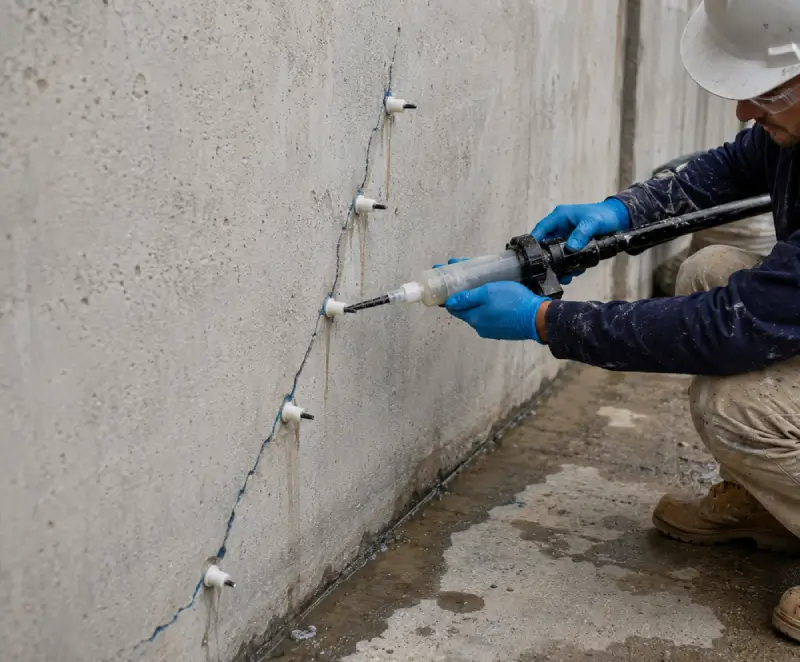
Crack injection solves this from within the crack itself. A resin is injected under pressure through a series of ports, filling the crack through its full depth and sealing it against water. Polyurethane injection is commonly used for active leaks, with hydrophilic and hydrophobic polyurethane resins reacting with water and expanding to form a flexible, watertight seal. For structural bonding, epoxy crack injection restores monolithic strength and provides a durable repair where structural crack bonding is required.
It is a specialist technique. The choice of resin, the injection pressure, the port spacing and the surface preparation all determine whether the seal holds. Done correctly, crack injection is one of the most durable and least disruptive remedial methods available — no excavation, no demolition, sealed from the inside.
Sealing Leaks In Structural Concrete
Basements & Lift Pits
Sealing leaking cracks in basement walls, lift pits and undercroft structures where water is entering under hydrostatic pressure.
Car Park Structures
Injection of cracked slabs, walls and construction joints in below-ground and elevated car parks to eliminate ingress and protect reinforcement.
Tanks & Retaining Walls
Watertight sealing of cracks in water tanks, bunds, retaining walls and other water-retaining or water-excluding structures.
Construction & Cold Joints
Treatment of leaking construction joints and cold joints, a common and often-overlooked ingress path in poured structures.
Structural Crack Bonding
Epoxy injection to structurally re-bond cracked concrete and restore load transfer, where specified by an engineer.
Active, Running Leaks
Fast-reacting polyurethane systems that seal even actively running leaks, curing in the presence of water.
How pressure injection seals a crack
Assess the crack
We determine the crack’s nature — active or dormant, structural or non-structural, wet or dry — which dictates the resin type and method.
Install injection ports
Ports are drilled and set at calculated spacing along the crack, angled to intersect it through the section, and the surface between them sealed.
Inject under pressure
Resin is pumped under controlled pressure from the lowest port upward, filling the crack through its full depth until it refuses.
Cure & finish
Once cured, ports are removed and the surface made good. For active leaks, the reaction forms a flexible seal that accommodates future movement.
Matching the resin to the crack
The single most important decision in crack injection is resin selection. We match the system to the specific conditions of your crack.
- Hydrophobic polyurethane — for active water leaks; reacts with water to form a firm, closed-cell watertight seal.
- Hydrophilic polyurethane — flexible seals in moving or damp cracks, accommodating ongoing structural movement.
- Epoxy resin — high-strength structural bonding of dormant cracks to restore monolithic concrete, where an engineer requires it.
- Correct pressure & port spacing — calculated to the section thickness and crack width to achieve full-depth fill.
Concrete Crack Injection Brisbane FAQs
Yes. Active leaks are exactly what hydrophobic and hydrophilic polyurethane resins are designed for — they react with the water present in the crack and cure to form a watertight seal, even while water is flowing. In many cases we can stop a running leak in a single visit.
For the crack that is injected, yes — a correctly injected crack is sealed through its full depth and stays sealed. Where a structure is subject to ongoing movement, flexible polyurethane systems accommodate that movement. If new cracks form elsewhere due to a broader structural issue, those would be separate — which is why we assess the cause, not just the symptom.
No — that is a key advantage. Injection is carried out from the accessible (usually internal, negative) side of the structure. There is no need to excavate around the outside of a basement or retaining wall, which makes it far less disruptive and costly than external tanking.
Epoxy injection can structurally re-bond a cracked section and restore load transfer, but whether a crack is structural — and how it should be treated — is an engineering question. Where structural cracking is involved, we work to an engineer’s specification.
Explore related work
Seal that leaking crack
Water entering through a concrete crack only gets worse — and corrodes the steel inside. Book an assessment and we’ll seal it at the source.