Rising damp, correctly diagnosed and treated.
Damp at the base of a wall is one of the most misdiagnosed problems in property. We establish whether it is genuinely rising damp — or condensation, a leak or penetrating damp — then treat the real cause, in Brisbane’s older masonry homes and heritage buildings.
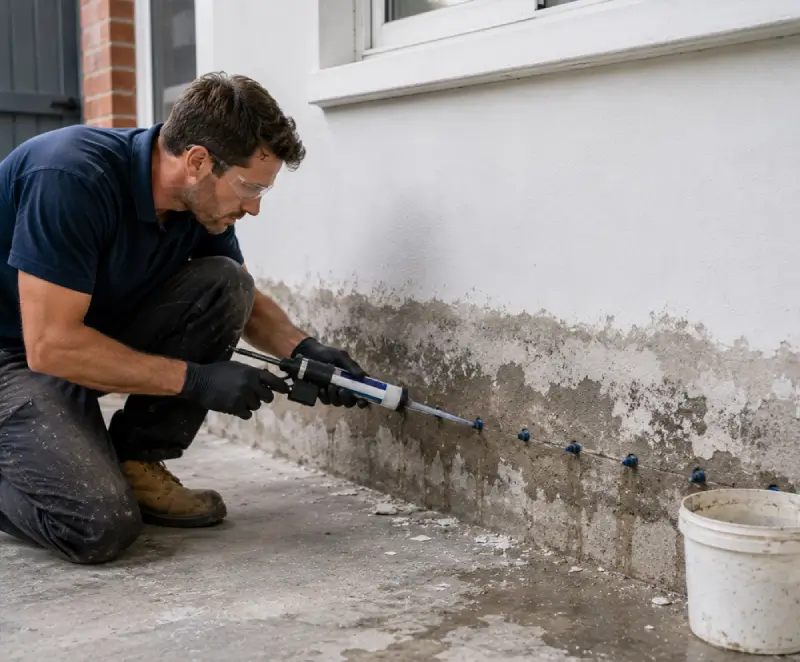
Most “rising damp” isn’t — and treating the wrong cause wastes money
Rising damp is real, but it is also over-diagnosed. When damp appears at the base of a wall, it is routinely blamed on rising damp when the true cause is something else entirely: condensation, a plumbing leak, penetrating damp through the wall, a failed sub-floor, or poor drainage directing water against the structure. Treating for rising damp when the cause is condensation achieves nothing except cost.
Genuine rising damp is groundwater drawn upward through porous masonry by capillary action, where the original damp-proof course has failed or was never installed — common in Brisbane’s older inner-suburb housing stock and heritage buildings. It carries dissolved ground salts that crystallise in the wall, damaging render and paint and leaving a characteristic tide line.
Our approach begins with diagnosis. We use moisture measurement and salt analysis to confirm whether damp is genuinely rising, and only then specify treatment — typically a chemical damp-proof course, removal and replacement of salt-contaminated render, and improved sub-floor ventilation. Get the diagnosis right and the treatment lasts; get it wrong and the damp returns.
Treating the cause, not the tide line
Damp diagnosis
Moisture measurement and salt analysis to confirm whether damp is genuinely rising — or condensation, penetrating damp or a leak.
Chemical DPC injection
Injection of a chemical damp-proof course into the masonry to create a new water-repellent barrier against capillary rise.
Salt-affected render removal
Removal of salt-contaminated render and plaster and reinstatement with salt-resistant systems that let the wall dry.
Sub-floor ventilation
Improvement of sub-floor ventilation and drainage to reduce ground moisture and support long-term wall drying.
Heritage & older homes
Sympathetic damp treatment in heritage-listed and character buildings, coordinated with heritage requirements.
Penetrating damp
Diagnosis and treatment of penetrating damp through walls and below-ground where that, rather than rising damp, is the cause.
Confirm the cause, then treat it
Diagnose & confirm
Moisture readings and, where needed, salt analysis to establish whether damp is genuinely rising, and to rule out condensation, leaks and penetrating damp.
Install a chemical DPC
Where rising damp is confirmed, a chemical damp-proof course is injected into the masonry to form a new barrier against further capillary rise.
Remove contaminated render
Salt-laden render and plaster is removed and replaced with salt-resistant systems — leaving old, contaminated render in place traps salts and moisture.
Support drying
Sub-floor ventilation and drainage are improved to reduce the ground moisture feeding the wall, and the wall is allowed to dry out over the following months.
How we tell rising damp from the impostors
Correct diagnosis is everything. These are the distinctions that determine whether treatment will actually work.
- Rising damp — a tide line up to about a metre, salt deposits and moisture worst at the base; groundwater rising by capillary action.
- Condensation — surface moisture and mould, often high on walls and in poorly ventilated rooms; a humidity problem, not a DPC one.
- Penetrating damp — localised patches linked to rain, a failed external surface or a bridged wall; enters horizontally, not vertically.
- Plumbing leaks — persistent localised damp unrelated to weather, traced to a pipe or waste; fixed by a plumber, not a DPC.
Rising Damp Treatment FAQs
Classic signs are a horizontal tide line up to roughly a metre above floor level, white salt deposits (efflorescence), and dampness that is worst at the base of the wall. But these can overlap with other problems, which is why we measure moisture and, where needed, analyse salts before concluding it is rising damp. We would rather tell you it isn’t and save you the treatment cost than treat the wrong thing.
It is a water-repellent treatment injected into a course of the masonry near the base of the wall, where it disperses and forms a new barrier that stops groundwater rising by capillary action — effectively replacing the failed or missing original damp-proof course. It is the standard modern treatment for genuine rising damp.
Rising damp carries dissolved ground salts that accumulate and crystallise in the render and plaster. Even after a chemical DPC stops the moisture rising, those salts remain hygroscopic — they draw moisture from the air and keep the wall looking damp. Removing the contaminated render and replacing it with a salt-resistant system is essential for a lasting result.
Yes. We treat rising damp in heritage-listed and character buildings using methods sympathetic to the fabric, and we coordinate with heritage requirements and consultants where applicable. Older solid-masonry walls need particular care to dry correctly, and we specify accordingly.
Explore related work
Find out what’s really causing your damp
Before you spend money treating rising damp, make sure that’s what it is. Book an assessment for an honest diagnosis and the right treatment.