Concrete leak Sealing Brisbane, from the inside.
When water is coming through concrete — a wall, slab, joint or penetration — we stop it at the source. Our concrete leak sealing Brisbane solutions use negative-side treatments, crystalline technology and resin injection to seal active leaks in existing structures without the need for excavation.
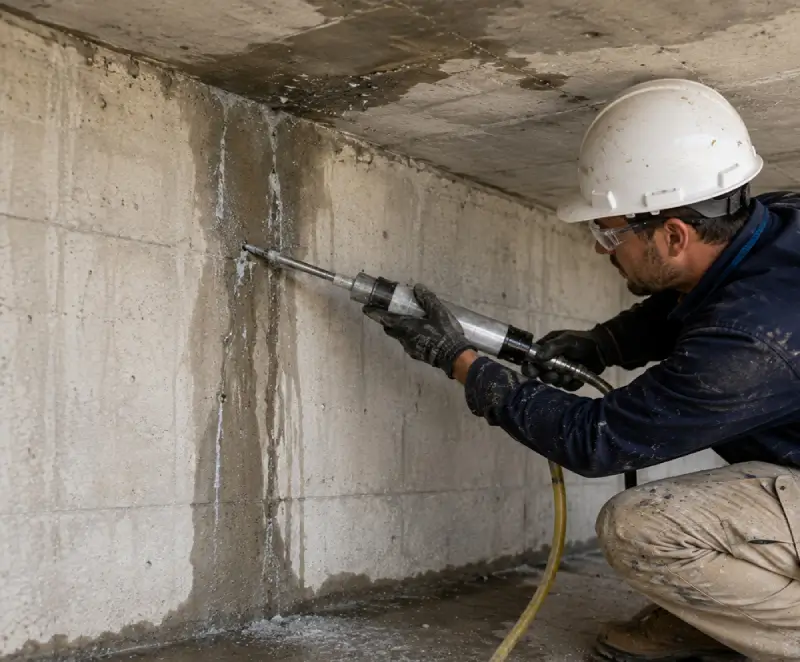
Water Under Pressure Will Always Find The Weakness
Concrete is not inherently waterproof. It is porous, can crack, and contains joints and penetrations — and where water is present on one side with pressure behind it, moisture can migrate through. In basements, tanks, retaining walls and below-ground structures, this can appear as damp patches, efflorescence, active drips or running water. Concrete leak sealing Brisbane helps address these water pathways at the source and restore a more reliable watertight barrier.
The ideal time to waterproof concrete is during construction, from the positive (water) side. But by the time a leak appears, that side is usually buried behind soil, backfill or another structure. Excavating to access it is enormously disruptive and expensive. This is where negative-side leak sealing comes in: treating the structure from the accessible, internal face.
We use a combination of technologies matched to the structure and the leak — crystalline systems that grow watertight crystals within the concrete pores, cementitious tanking slurries, and pressure injection for cracks and joints. Our concrete leak sealing Brisbane solutions are designed to stop water ingress from within the structure, helping deliver a dry, sealed environment without excavation.
The Right Technology For The Concrete Leak Sealing
Crystalline Systems
Cementitious crystalline treatments that react with moisture and cement to grow watertight crystals deep within the concrete pore structure.
Negative-Side Tanking
Cementitious tanking slurries applied to the internal face to seal walls and slabs against water under hydrostatic pressure.
Crack & Joint Injection
Polyurethane and epoxy injection to seal discrete cracks, construction joints and cold joints acting as leak paths.
Basements & Tanks
Sealing of leaking basements, water tanks, lift pits and below-ground rooms to achieve and maintain dry internal conditions.
Penetration Sealing
Watertight sealing around pipes, conduits and service penetrations that breach below-ground and water-retaining walls.
Retaining Walls
Treatment of damp and leaking retaining walls from the internal face, addressing both seepage and the drainage feeding it.
Diagnosis To Dry Structure
Locate the source
We identify where and how water is entering — diffuse seepage through the slab, a discrete crack, a joint or a penetration. Each demands a different treatment.
Prepare the surface
The concrete is cleaned back to a sound, open substrate, cracks are routed, and any active flows are stemmed with rapid-set plugging compounds.
Apply the system
Crystalline slurry, cementitious tanking, injection or a combination — applied to the specification suited to the structure and the water pressure.
Verify dry conditions
We monitor the treated area to confirm the leak is stopped and dry conditions are achieved before finishing.
Why negative-side sealing is often the only practical option
Understanding which side of the structure you can treat is central to leak sealing in existing buildings.
- Positive side — the ideal, water-facing side; usually only accessible during original construction, before backfill.
- Negative side — the internal, accessible face; where nearly all remedial leak sealing must be carried out.
- Crystalline technology — works from the negative side by growing crystals into the concrete, resisting pressure from the positive side.
- No excavation — negative-side treatment avoids the enormous cost and disruption of digging out a buried structure.
Concrete Leak Sealing Brisbane FAQs
Yes. Negative-side sealing — crystalline systems, cementitious tanking and injection — is specifically designed to seal structures from the internal, accessible face, resisting water pressure coming from the buried side. It is the standard approach to basement and below-ground leaks where excavating the outside is impractical.
Crack injection targets a discrete crack or joint. Concrete leak sealing is the broader discipline — it includes injection, but also addresses diffuse seepage through the body of the concrete using crystalline and cementitious systems. We often combine methods on a single structure: injection for the cracks, crystalline for the general seepage.
Efflorescence — the white salt deposits left as water evaporates through concrete — stops appearing once the water movement causing it is halted. By sealing the leak at its source, the underlying cause of the efflorescence is removed. We clean back existing deposits as part of surface preparation.
Very. Because crystalline systems become part of the concrete itself — growing crystals within the pore structure — they are not a surface coating that can peel or wear away. The crystalline action can also reactivate in the presence of new moisture, offering a degree of self-sealing for fine future cracking.
Explore related work
Get Your Structure Dry
Damp patches, efflorescence or active leaks in concrete don’t resolve on their own. Book an assessment and we’ll seal the structure from the inside.